Research
I studied the brain as if it were an island. It isn't.
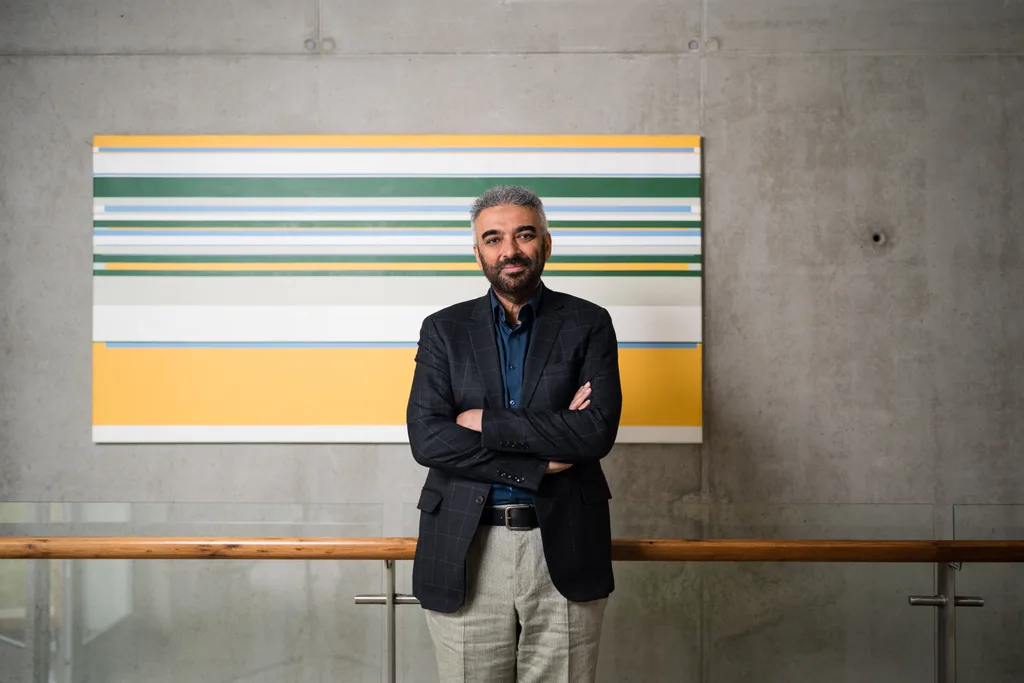
I am an engineer by training — electrical engineering, then nuclear engineering, then information and communication, and a doctorate in mechatronics. I spent those years learning to think about systems: circuits, signals, the way a fault in one place reveals itself somewhere else entirely. Then I became fascinated by the most complicated network ever assembled, and for almost three decades I have worked as a neuroscientist, building tools that read the brain's faint electrical signals to catch the early fingerprints of stress, anxiety and depression.
I was trained to find the signal. Show me a brain and I will find you the marker for depression — one organ, one measurement, one answer. Without quite noticing, I had absorbed the deepest assumption of modern medicine: that the body is a collection of separate departments. I studied the brain the way a cardiologist studies the heart.
It is not an island. The brain I was scanning was in constant conversation with the gut, syncing its rhythms to the pulse, shaped night after night by sleep, flooded or starved by what the person had eaten, lifted or pressed down by whether they had spoken to someone they loved that week. The depression I was hunting for in the electrical signal was very often not starting in the brain at all. I had been handed a fault in the network and told to study the one wire where it happened to show up.
That changed the question. I had spent a career trying to detect illness earlier and earlier — a good aim, but detection is still a response to something already breaking. The real prize is further upstream: understanding the whole system well enough that the disorder never takes hold. Less treatment, more prevention. It is what I now say in every lecture hall I am invited into.
50+
h-index
13,000+
citations
200+
scientific publications
7
granted patents
30+
PhD supervisions
Workplaces
I head the Cognitive and Neural Engineering group at Brno University of Technology. From 2009 to 2018 I worked at the Malaysian National Centre of Neuroimaging at Universiti Teknologi PETRONAS, where much of my brain-imaging work was done.
Throughout, shoulder to shoulder with the clinicians who treat these conditions every day:
Hospital Universiti Sains Malaysia · Brain Therapy Center, Australia · King Fahd Specialist Hospital, Saudi Arabia · Spectrum Learning, Singapore · Neurofeedback Services of New York · Masaryk University, Brno
I serve as Associate Editor of Frontiers in Digital Health, sit on the board of the Asia-Pacific Neurofeedback Association, and examine doctoral candidates for universities in Australia, the Czech Republic, France, India, Malaysia, Pakistan and the United Kingdom.

Funding
Seventeen funded projects across the Czech Republic, Malaysia and France. The one just completed is the argument of this page, built as research:
HATS — Home-based Assessment and Tracking System for Early-Stage Stress, Anxiety and Depression
Technology Agency of the Czech Republic · 2025–2026
Earlier work includes stress in the urban workplace, treatment management for major depressive disorder, and the effect of display technology on learning and memory.
Teaching
Over the years I have taught a wide range of courses, from pure engineering through applied subjects to biomedical ones. Today I teach four, and all four are about the brain.
Publications
Twelve out of more than two hundred, oldest first — because read in order, they are the argument at the top of this page.
Edge refinement method for content-based image retrieval
IEEE Systems, Man and Cybernetics, Tokyo · 1999
Multiscale segmentation of HRCT images using bipolar incoherent filtering
Springer Lecture Notes in Computer Science · 2005
A novel algorithm for estimation of depth map using image focus for 3D shape recovery in the presence of noise
Pattern Recognition · 2008
Simulation-based analysis of the resolution and SNR properties of partial k-space EPI
Concepts in Magnetic Resonance Part B · 2009
P300 correlates with learning and memory abilities and fluid intelligence
Journal of NeuroEngineering and Rehabilitation · 2015
Automatic diagnosis of alcohol use disorder using EEG features
Knowledge-Based Systems · 2016
A wavelet based technique to predict treatment outcome for Major Depressive Disorder
PLOS One · 2017
An EEG-based functional connectivity measure for automatic detection of alcohol use disorder
Artificial Intelligence in Medicine · 2018
Mitigation of stress: new treatment alternatives
Cognitive Neurodynamics · 2018
Towards health monitoring using remote heart rate measurement using digital camera
Measurement · 2020
Unveiling neural signatures: a comprehensive review of EEG biomarkers in stress, anxiety and depression
IEEE Transactions on Affective Computing · 2026
Try the biomarker toolUnravelling cognitive impairments in mental and neurological disorders: a biomarker-based mapping framework
Neuroscience and Biobehavioral Reviews · 2026
Try the mapping tool
The complete record
lives where it is maintained.