Three Weeks of Lying Still
Something gets harder, and the easiest excuse is age. The second and third flight of stairs that used to be nothing. The hill at the end of a walk you have taken for years. The grocery bags that now go up in two trips instead of one. It happens quietly, across a decade, and nobody ever questions the explanation, because the explanation is printed on our birth certificates.
But guess what: Science refutes it. The best evidence I know comes from five healthy twenty-year-old men who, in 1966, volunteered to spend three weeks in bed.
Not resting on anyone's orders. For science. For twenty-one days they lay flat, doing nothing at all, while researchers measured what happens to a body that simply stops moving.
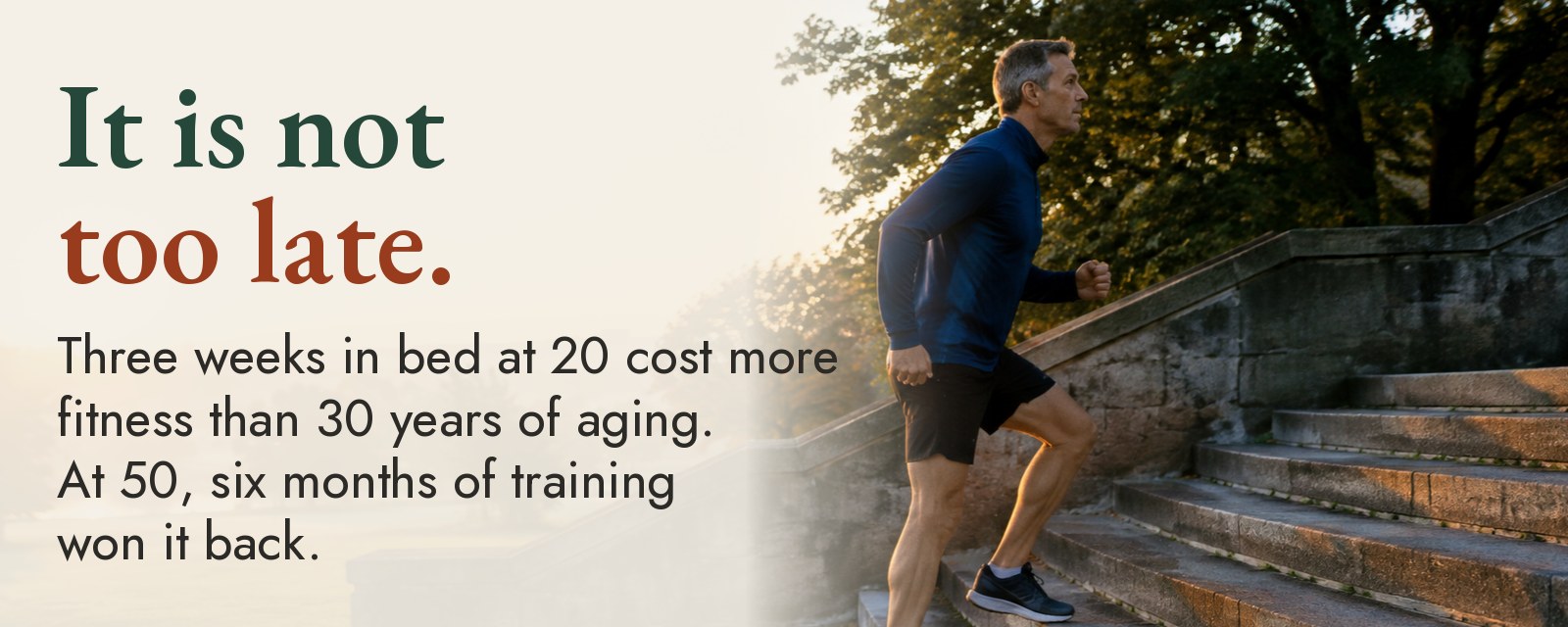
What happened was startling. In three weeks their VO₂max, the size of the engine that carries oxygen from the air to a working muscle, fell by 27%. Three weeks of lying still had done to their hearts and lungs roughly what you would expect from decades.
The part that made it famous
That alone would make a fine cautionary tale. The Dallas study became legendary because the scientists did something almost nobody does: they kept those five men on the books, and came back for them thirty years later.
Now in their fifties, the men were measured again. Across those thirty years of ordinary living, of jobs and dinners and birthdays, their VO₂max had fallen by 12%.
Set the two numbers side by side and let it land. Three weeks in bed at twenty had cost them more of their engine than three entire decades of aging. Twenty-one days of stillness was, for their hearts and lungs, worse than getting thirty years older.
A large share of the decline we blame on the calendar is not aging at all. It is disuse. It is the chair.
Your body is the one machine in the world that falls apart when you fail to run it. Leave a car in a garage for thirty years and it seizes and rusts. Leave a body in a chair and the same thing happens, only faster.
And the good news hiding inside that grim fact is enormous. If the problem is mostly disuse, then the fix is mostly use.
The curve bends
The Dallas study showed that too, and this is the part that gives me chills.
Those same five men, now fifty years old, were put through six months of endurance training. Their VO₂max climbed 14%, back to exactly where it had been when they were twenty. Six months of training had made up the whole of thirty years' worth of decline. In a real and measurable sense, they had their twenty-year-old engines back, at fifty.
They are not a special case either. Study after study points the same way: healthy people in their sixties and seventies respond to training to a similar relative degree as people in their twenties, largely regardless of age, sex, or where they started.
So let me say the most hopeful sentence I know as plainly as I can. It is not too late. It has almost certainly never been too late. Whatever your age, and whatever shape you are in this morning, the curve bends. And it bends upward the moment you start.
What this does not promise
Five men is a small study, and one remarkable follow-up is not a promise to any single person. What earns it your attention is that the much larger body of training research points in the same direction.
And the clock itself does not stop. Nobody can hand you back the years. What the evidence actually says is narrower than a slogan and still worth a great deal: at any age, you can walk yourself a long way back up that hill.
One thing worth doing this week
Here is a question worth about a minute of your morning.
What have I quietly stopped doing because it got hard?
Not a goal. A specific thing you once did without negotiating with yourself: the stairs instead of the elevator, the hill at the end of the street, the top shelf, getting down on the floor with a child and back up again in one motion. Most of us keep a short list like that. We never say it out loud. Every item on our list left so gradually that no single day was the day it went.
Pick one. Start doing it this week. Then next week. That is the entire assignment, and it is the Dallas result in miniature: the capacity you use is the capacity you keep.
Those five men did not get their twenty-year-old engines back in a week. They got them back because they kept going for months. Consistency is the key. Start and keep doing it.
One caution, and I mean it. If you have a heart condition, or you get chest pain or unusual breathlessness when you exert yourself, or you have not been active for a long stretch, talk to your doctor before you add hard effort. Start with the easy version of your one thing, and let it get easy before you let it get harder.
This is from Chapter 7, Move Like It Matters.
Thank you for reading. See you next Wednesday.
Aamir