A Night in Five Acts
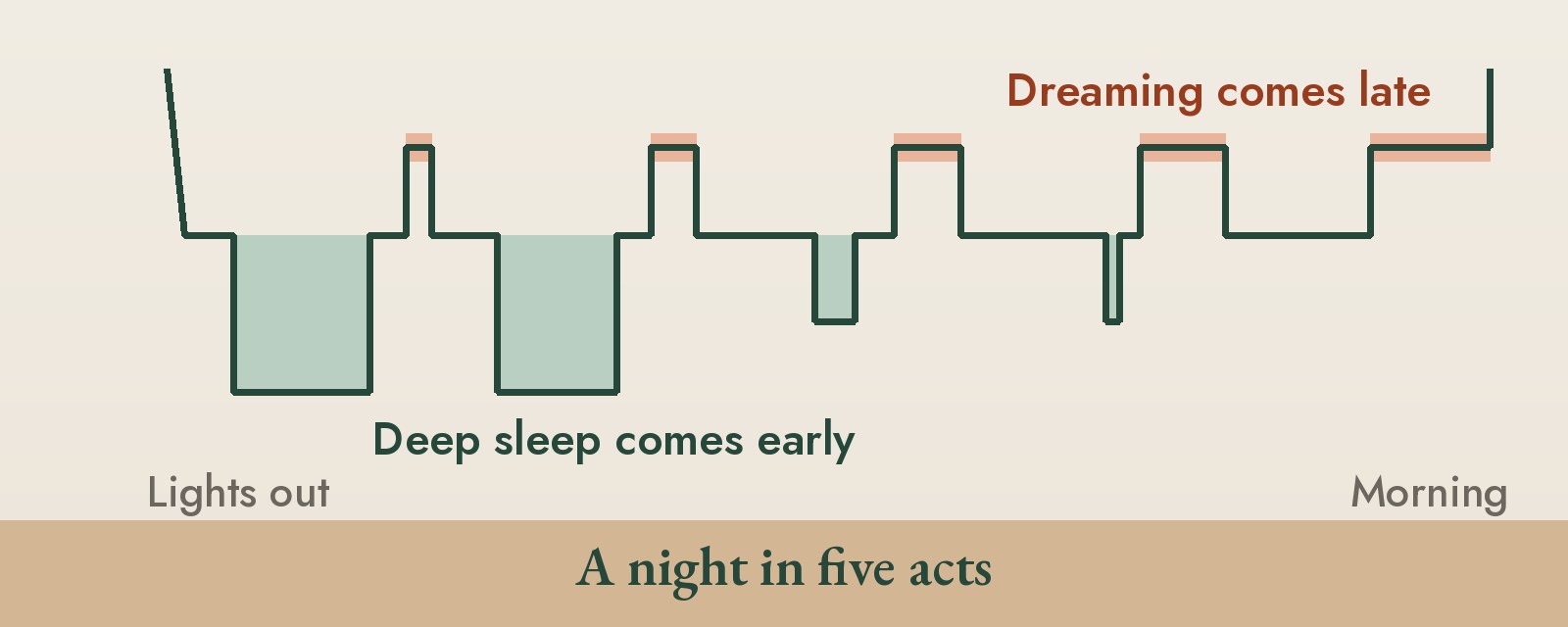
You might imagine sleep as a single flat thing: lights out, lights on, a blank in between. It isn't. A night of sleep is a structured journey, repeated several times over. Sleep scientists call the basic unit a cycle, one full loop down into the depths of sleep and back up again. Think of it as one lap of the pool. Each lap takes roughly 90 minutes, and across a healthy night you swim about four or five of them.
Learning to read that structure is the single most useful thing you can know about sleep, because almost every complaint people have about their nights turns out to be a complaint about its shape.
The five acts
A sleep lab scores five states: plain wakefulness, and four stages of sleep.
- Awake: a few brief surfacings between cycles are normal, and you usually won't remember them.
- Stage 1, the doorway: a light, drifting doze of a few minutes, where you might twitch or feel yourself falling. Only about 5% of the night.
- Stage 2, the workhorse: genuine sleep, and roughly half the night. Your heart rate and temperature drop, and your brain fires off little bursts that help keep you asleep and appear to help cement memory.
- Stage 3, deep sleep: long, rolling brain waves, and very hard to wake from. This is when the body does its heavy repair: the growth-hormone surge, the tissue rebuilding, the immune servicing, the brain's waste-clearing rinse. About 15 to 20% of the night.
- REM (Rapid Eye Movement), the dreaming: the brain becomes almost as active as when you're awake, the eyes flick beneath the lids, and the body is held still by a clever safety lock that stops you acting out your dreams. This is where the emotional and creative work happens: the day's feelings get processed, and new information gets woven into what you already know. About 20 to 25% of the night.
The part that unlocks everything
The mix is not even from one cycle to the next. Deep sleep is front-loaded: your body takes its heavy repair early, in the first couple of cycles. REM is back-loaded: the dreaming periods start short and grow longer with each cycle, so the richest REM arrives in the hours just before you wake.
That single fact explains a surprising number of things.
An early alarm is a clean REM problem. Go to bed on time but cut the morning short, and you slice off the long dreaming periods you would have had near dawn. That is one reason you can sleep a decent number of hours and still wake foggy and emotionally raw.
A late night is a blunter problem. Go to bed two hours late but still wake at the same time, and your body still fights to take some deep sleep early. What you mostly lose is total sleep, and whichever stage would have come last.
And being woken again and again, by a noise, a child, a full bladder, is corrosive even when your total hours look fine, because each awakening can drop you back to the shallows to climb again. You never bank enough of the deep and dreaming sleep that actually count.
Two honest notes
The shape changes with age. Deep sleep is abundant in childhood and declines across the decades, which is part of why older adults often sleep lighter and wake more. That is normal, not necessarily broken.
And people differ. A genuine minority are larks or owls by their genes, falling asleep and waking naturally earlier or later than most. But don't take this as an excuse of being a lark or an owl because majority is not. My book guides you to find out if you really are one.
One thing worth doing this week
Read your mornings against the shape of the night. For one week, jot down three things each morning: the time you woke, whether the alarm woke you or you woke on your own, and how clear you felt in the first hour.
If the foggy, raw mornings line up with the alarm cutting the night short, the place to work is the start of the night, not the end: an earlier lights-out, with your wake time kept where it is. If they line up with broken nights, look at what wakes you that you can control, such as noise, light, or a phone that lights up beside the bed.
And one line worth keeping close: some sleep trouble is not about habits at all. If you snore loudly, gasp or choke in the night, or someone has told you that you stop breathing, or if you nod off during the day without meaning to, that is a visit to a doctor, not a matter of better habits.
This is from book's Chapter 6, Sleep: The Foundation.
Thank you for reading. See you next Wednesday.
Aamir