What Predicted Health at Eighty
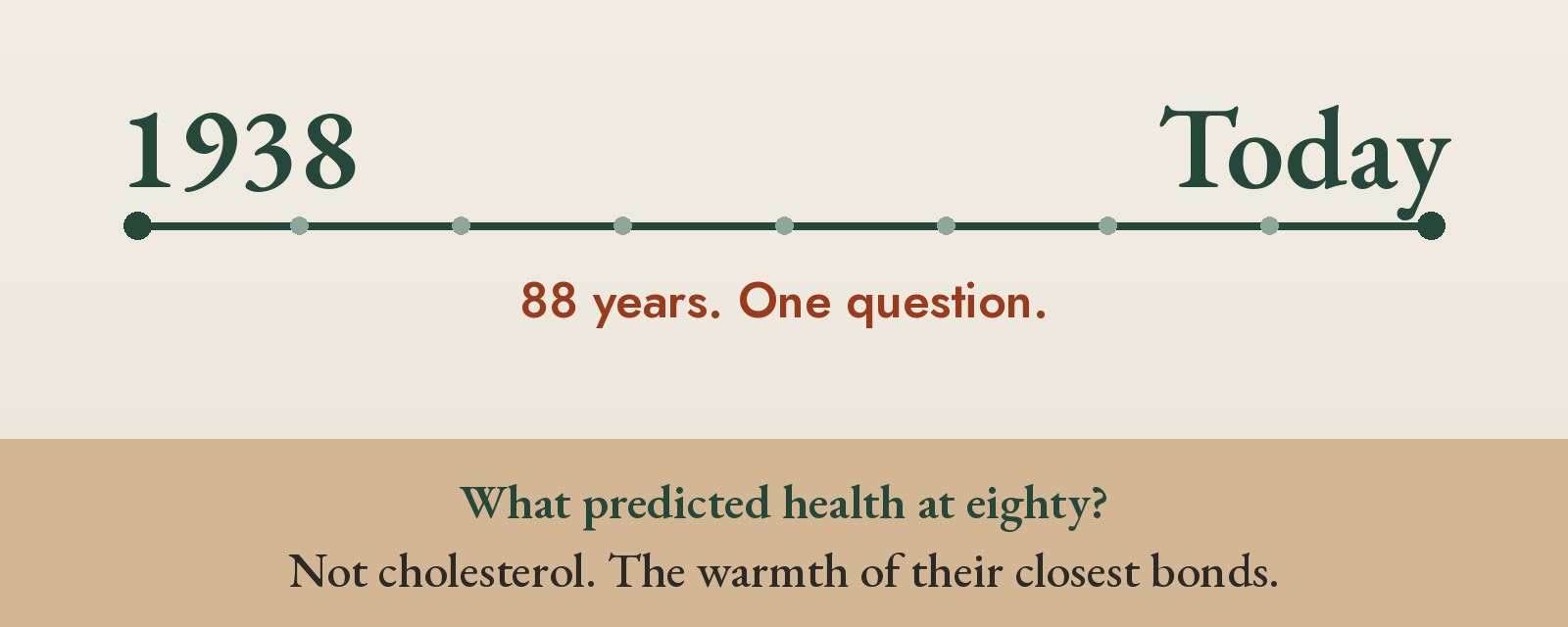
In 1938, as the Great Depression ground on and a second world war gathered in Europe, a group of Harvard researchers began an experiment so patient that almost none of the people who started it would live to see how it turned out.
They decided to take a group of young people and simply follow them. Not for a year, or ten. For life. Their health, their work, their loves, their disappointments, year after year, with the same quietly enormous question the whole way: what actually makes a human life go well?
Who they followed
They began with 724 participants, and, in a limitation that says everything about 1938, all of them were men and boys. Some were privileged: 268 sophomores at Harvard, the young men the world expected great things from. The other 456 came from the poorest tenements of inner-city Boston, boys for whom the world expected very little.
The study did not stay a men's club. Over the years the researchers brought in the participants' wives, then their children, daughters as well as sons, and today it follows more than 1,300 descendants. They drew blood, mapped families, sat in living rooms, and kept coming back through marriages and divorces, careers and firings, the births of children and grandchildren. Eighty-eight years and four directors later, the Harvard Study of Adult Development is still going. It is the longest in-depth study of human life ever conducted.
A study that runs that long cannot be fooled by what we think makes a good life. It only records what actually did.
The question at eighty
When the participants reached eighty, the researchers went back to everything they had measured at fifty and asked: of all of it, what best predicted who would arrive at eighty healthy and happy, and who would arrive sick, sad, or not at all?
The smart money was on cholesterol, blood pressure, the numbers on the doctor's chart.
It wasn't even close. Robert Waldinger, the study's current director and a psychiatrist at Harvard Medical School, has summarized it bluntly. Of everything on file about these men by midlife, the strongest signal of how well they would age was not a cholesterol reading but the warmth of their closest bonds. The men happiest in those relationships at fifty turned out to be the healthiest at eighty. The result surprised the team enough that they ran it again. It held.
The detail is more moving than the headline. It wasn't the number of friends, or whether someone was married on paper. It was the quality of the closest bonds. Among couples in their eighties, those in happy relationships found that on days when physical pain was bad, their mood held steady anyway. And women in the study who felt securely attached to their partners were less depressed, happier, and even held on to sharper memory than those in relationships full of conflict.
The part most people leave out
If I stopped there, you would close this letter believing what half the internet believes: that relationships are the one secret. The same study says something more honest, and more useful.
Relationships were a star player. They were not the only player. When George Vaillant, one of the study's long-time directors, sifted the data for what predicted a healthy old age, he found not one magic factor but a handful working together, among them staying physically active, keeping a healthy weight, mature ways of coping with life's blows, and warm, stable relationships. Asked what makes a life go well, the longest study of its kind came back not with one answer but with several pillars at once.
There is a second honesty. The people in this study had food, shelter, work and a measure of safety. Relationships rose to the top among people whose basic needs were already met. That is not a smaller claim. It is a truer one.
Vaillant, asked to compress it all, gave two answers. The careful scientist's answer was the list. The other came down to three words. Happiness, he said, was love. Both are true.
One thing worth doing this week
Social connection is one of the 5 pillars in my book. What this pillar asks of you is almost comically small. In one 2021 study, simply giving people brief, friendly phone calls a few times a week rapidly lowered their depression, anxiety and loneliness.
So this week, think of the people you could call. Put something standing in the calendar: the same walk, call or meal at the same time each week, so that connection stops depending on anyone's willpower. And reach out first. We chronically underestimate how glad people will be to hear from us.
This is from book's Chapter 5, The People Prescription.
Thank you for reading. See you next Wednesday.
Aamir