The Size of Your Engine
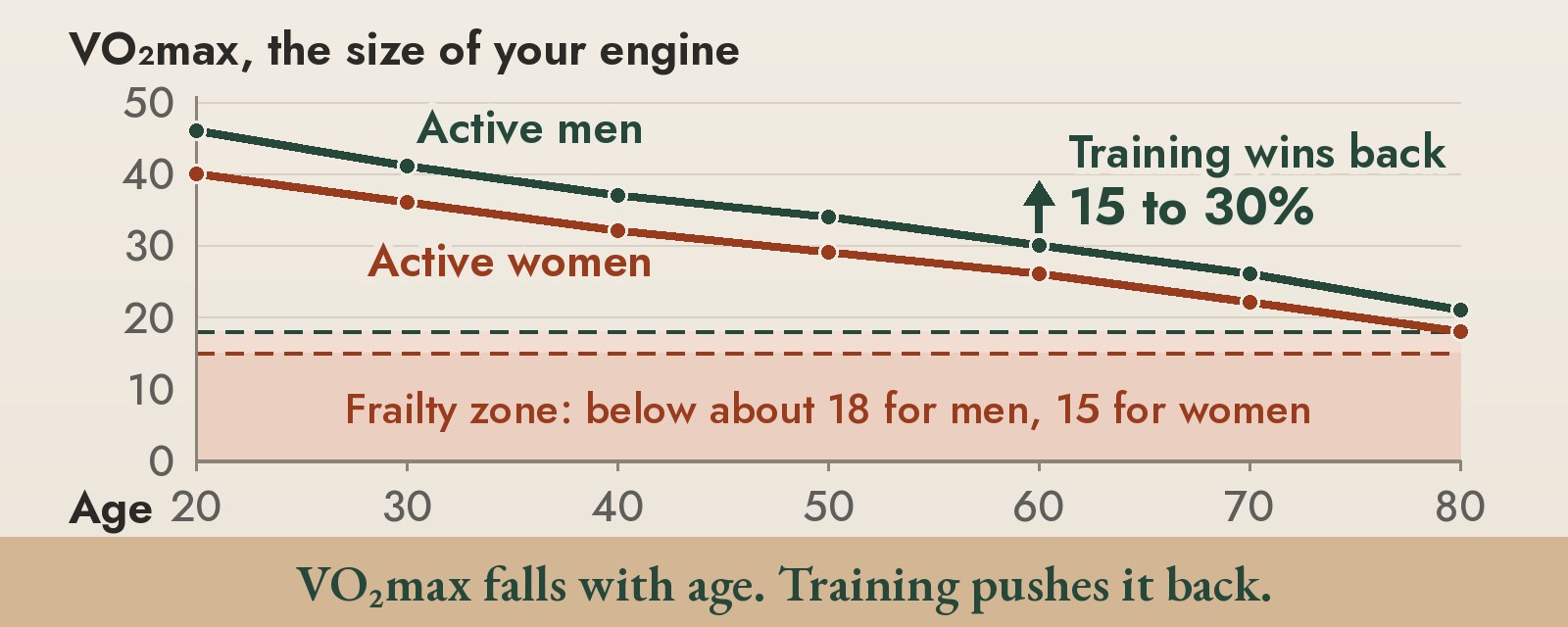
Let me introduce you to what may be the most important number about your body. It has an intimidating name, VO₂max, that makes it sound like something only Olympic coaches care about. Ignore the name. It is the maximum amount of oxygen your body can take in and use in a minute of all-out effort. That's it. It is the size of your engine.
Why one number says so much
To get oxygen from the air into a working muscle, a whole chain of systems has to work together. Starting with the lungs pulling in the air and loading your blood with oxygen. Heart gets oxygen enriched blood from the lungs and pumps it. Your blood and vessels carry and deliver it. Your muscles, down at the level of the cell, actually burn it. VO₂max measures that whole chain in a single reading. Rather than a simple fitness metric, it serves as a warning light for the entire body.
And it predicts a great deal. A Cleveland Clinic study followed more than 120,000 people whose fitness had been measured on a treadmill. The least fit had roughly five times the risk of dying compared with the fittest, and the benefit had no ceiling: the fitter people were, the longer they lived, all the way up.
You can feel it in your legs
Figures like that can feel abstract, so here is where VO₂max actually lives. A person with a big engine climbs three flights of stairs and keeps talking at the top, runs for a closing gate and makes it, takes the hill on a hike without becoming the reason everyone stops. A person with a small one can't, not for lack of willpower, but because the engine can't move enough oxygen fast enough, so everything above a stroll tips into breathlessness.
A fit fifty-five-year-old wouldn't notice a brisk walk. A less fit one experiences that same walk as strenuous exercise. Same walk. Different engine.
The slope, and the line on it
Left alone, VO₂max falls every decade. Between twenty and seventy, someone who does nothing about it can lose more than 40% of their engine.
Check the graph at the top which shows a line worth knowing about: the frailty threshold, a working figure of around 18 for men and 15 for women, in the units the labs use (milliliters of oxygen per kilogram of body weight per minute). Below it, the ordinary tasks of an independent life, rising from a chair, climbing your own stairs, walking to the store, become too hard. That is what this number is really about.
The best news
The most important thing about VO₂max is not that it falls. It is how readily it rises. Training can win back something like 15 to 30%. To put in context, a sedentary sixty-year-old who trains can carry the fitness of a forty-year-old. People who keep training cut the rate of decline by roughly half.
You will feel it long before any test confirms it. The stairs that used to wind you stop winding you. Your regular walk feels easier. Your breath comes back faster after effort. Those aren't vague good feelings. They are your engine getting bigger.
One thing worth doing this week
There are two tools, and the first is gentler than you would guess.
The base is called Zone 2: easy, steady, conversational effort. A brisk walk, an easy jog, an unhurried bike ride. The test is your voice. If you're gasping, you've gone too hard; if you could sing, it's too easy; if you could hold a full conversation while still knowing you're working, you're there. Three or four of these a week, twenty to sixty minutes each, build the supply side of your engine. It feels almost too relaxed to be doing anything, which is exactly why people skip it.
The ceiling, once you have a base, is intervals. The best-studied recipe is the Norwegian 4×4: after a warm-up, four minutes of high intensity training reaching a threshold where heavy breathing makes conversation difficult followed by four minutes easy, four times over. One or two of these a week is plenty.
So this week, do just one thing: put three Zone 2 sessions in your calendar and keep them conversational. If you are starting from the couch, leave the 4×4 for a few weeks, until easy jogging or cycling feels comfortable. And if you have a heart condition, or haven't been active for a long time, talk to your doctor before you add the hard sessions.
This is from book's Chapter 7, Move Like It Matters.
Thank you for reading. See you next Wednesday.
Aamir