Eat the Orange
How many oranges could you eat in one minute?
Picture it honestly. You pick one up, break the peel, work it apart and actually chew: pulp, fiber, the resistance of real food. You could hardly manage one. Yes you may go for a second one but notice the time it takes you to eat. Long before a third, your jaw is tired and your stomach is telling you it has had enough.
Now think. How many oranges could you drink in one minute, poured as a tall glass of "100% natural, not from concentrate, no added sugar" orange juice?
Four. Easily. No peel, no chewing, no fullness: a cool, virtuous glass gone in a few swallows, with room for more. Same fruit. Utterly different act. And in the gap between eating an orange and drinking one lives one of the most successful little deceptions in the modern kitchen. Researchers call it the health halo.
What the glass leaves behind
Scientists have come up with a term called food matrix which simply points to the bonding and organization of physical and chemical structure of the food. Juicing destroys that matrix. The blade tears away the fiber (the pulp, the pith, the cell walls) and sets the sugar free.
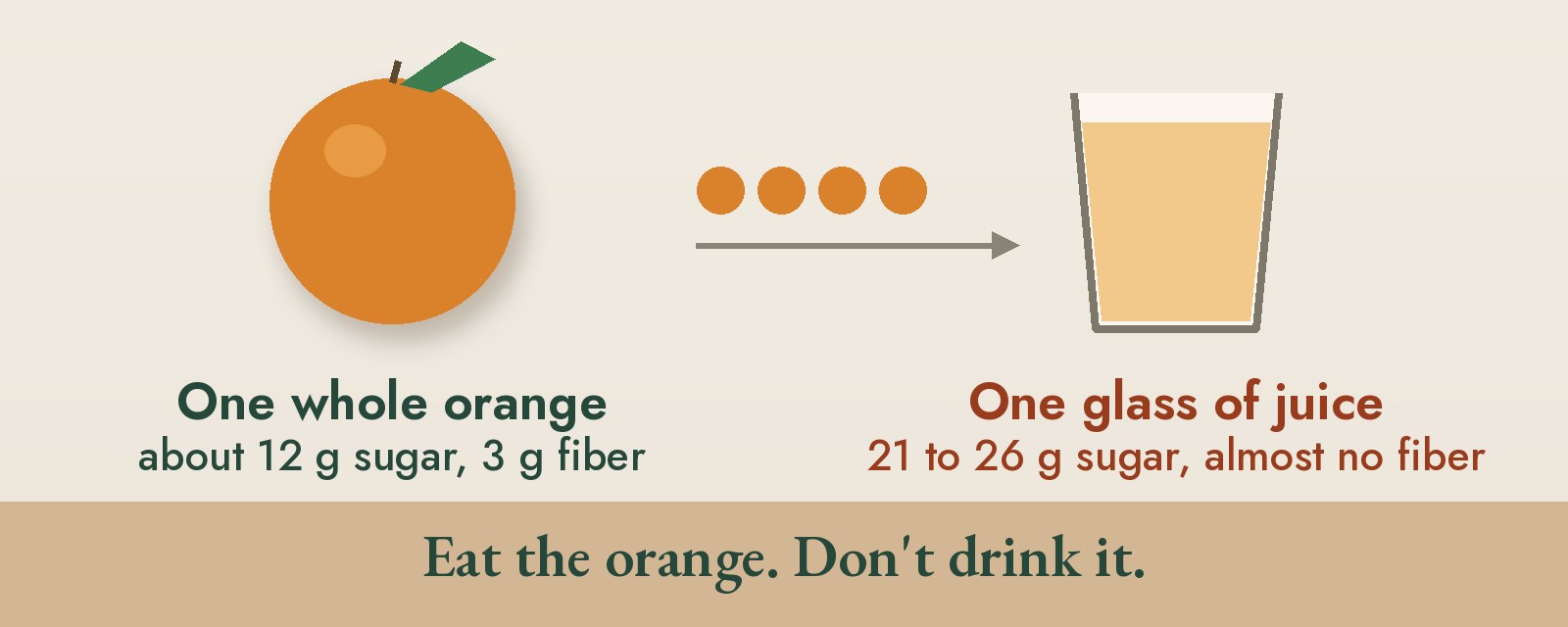
A whole medium orange carries about 12 grams of sugar wrapped in roughly 3 grams of fiber, and that fiber is the star of the matrix. The soluble kind forms a soft gel in your gut that slows how fast the sugar can reach your blood. Fiber is nature's speed limiter.
Now pour the glass. A medium sized 250 ml serving (about 8 fl oz) of orange juice delivers around 21 to 26 grams of sugar, the juice of three to four oranges, with almost no fiber at all. Take away the speed limiter and the sugar floods in. That is why a glass of "healthy" orange juice carries roughly the sugar of a glass of cola, and why its effect on your blood sugar is nearly as steep.
It's measured, not rhetoric
Strip the fiber and pour several oranges into one glass, and you roughly double or triple the glycemic load of a single orange: the same sugar, arriving faster, in a form that fills you up far less.
Research backs it up. A landmark 2013 study in the British Medical Journal, tracking 187,382 people, found that eating whole fruit was associated with a lower risk of type 2 diabetes, while drinking fruit juice was associated with a higher one. Simply swapping three weekly servings of juice for whole fruit was tied to a measurable drop in that risk. The World Health Organization counts the sugar in fruit juice as a free sugar, the same category as the sugar stirred into soda.
The halo, it turns out, is only on the label. Your pancreas can't read it.
What this is not
Don't get me wrong, I actually like fruit. Whole fruit is one of the finest things you can eat: fiber, water, vitamins and a thousand protective compounds, all working together, and all self-limiting, because chewing slows you down. Eat it freely, without a shred of guilt. A splash of juice on an occasional celebratory morning, will not undo you either.
The target is the daily habit built on a misunderstanding: a large glass every single morning, drunk in the belief that it is the virtuous choice, when the honest label would read "three oranges of sugar, fiber removed."
One thing worth doing this week
If juice is part of your morning, swap it for the fruit itself for seven days. Eat the orange, and notice how you feel.
Every time something carries a halo word on the front (natural, pure, low-fat, no added sugar), turn it over and read the sugar and fiber lines on the back. The halo works by switching off our suspicion. "Zero sugar" says nothing about the fat. "Low-fat" says nothing about the sugar. And for years it often meant sugar had been added back to rescue the taste.
Once you start looking, you will see the same pattern everywhere: take a whole food, strip away part of it, concentrate what is left, and wrap it in a word that sounds good. Dried fruit is fruit with the water and many nutrients with it taken out. A handful of raisins can carry the sugar of a whole bowl of grapes, eaten in seconds.
The rule underneath it
The closer a food is to the form nature made it, whole and intact, the more it nourishes you. Your body knows the difference, even when the marketing hopes you won't.
Eat the orange. Don't drink it.
This is from Chapter 9, The Balanced-Diet Deception.
Thank you for reading. See you next Wednesday.
Aamir