The Exercise You Keep Skipping
If you already exercise several times a week, good. Keep doing it. This letter is not about replacing that. It is about the other twenty three hours of your day, most of which, for most readers, are spent sitting: at a desk, in a car, on a couch.
The workout is not the problem
A single session of movement, however good, does not cancel out ten hours of stillness around it. The research on this is fairly blunt: long unbroken stretches of sitting carry a cost that a single daily workout only partly offsets, no matter how hard that workout is.
This is not an argument against exercising. It is a reminder that the workout and the rest of your day are two separate questions, and most advice only answers one of them.
The smallest dose that seems to matter
The useful move is not a longer or harder workout. It is breaking up the stillness itself: a few minutes of movement roughly every hour, standing up, walking to another room, a short flight of stairs, even a minute of stretching at your desk. Several short breaks in sitting appear to do more for the markers that matter, blood sugar, circulation, how your joints feel by evening, than the same total minutes spent in one longer block later in the day.
This is good news if you have decided you do not have time to exercise. The dose that seems to matter most does not need a block of time at all. It needs an interruption.
One thing worth doing this week
Set a repeating reminder, on your phone or your computer, once an hour during your working day. When it goes off, stand up and move for a minute or two: walk to get water, climb a flight of stairs, or just pace while you think through whatever you were doing. Do this for one week, and notice, by Friday, whether the familiar late afternoon slump feels any different.
That is the whole exercise, and it costs you nothing you were not already going to spend on your workday.
If an hourly alarm will not work for you
Some days do not allow for it. A long meeting, a drive, a shift where you cannot simply stand up. For those days, attach the movement to something that already happens rather than to a clock. Stand and move for a minute at the end of every meeting, before you open the next email, or every time you refill a glass of water. The trigger matters less than having one, because a reminder tied to an event you cannot skip survives a busy day in a way that a phone alarm, easily silenced, often does not.
The goal is the same either way: break up the sitting somewhere close to every hour, not to hit a step count, and not to earn anything. Just to interrupt it.
Why this pillar earns its own chapter, and then some
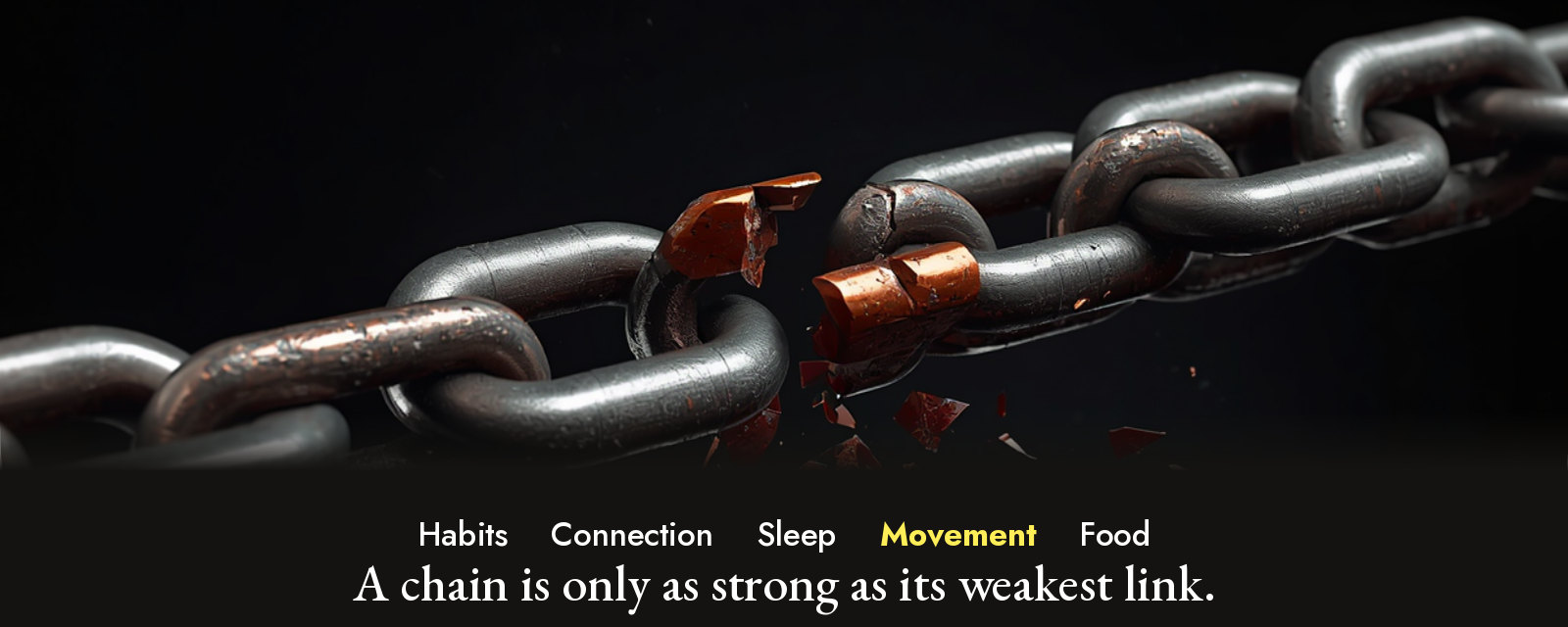
It would be easy to read all this and assume movement is the least demanding of the five pillars, since the bar here is so low. The book argues close to the opposite: because movement is so cheap to add back in small doses, it is usually the fastest pillar to show a payoff, often within days, which makes it a good one to start with if you are not sure where your own weakest link is.
A short note, since it is finally true
Fix the Floor came out this month. It is the book behind these letters, and it goes through this pillar and the other four in full, including how to score your own movement honestly at home. If you have been waiting for it to arrive before picking it up, it has. This letter is not the pitch for it. Next week's will go back to being about one useful thing, same as always.
Thank you for reading, and for sticking with these letters through the launch. See you next Wednesday.
Aamir