Everything Right, Still Wrong
I am not a doctor. I want to say that at the start, because it matters, and because this first letter is about a mistake I made for most of my working life.
For almost three decades my work has been reading brains. Brain imaging, mostly: looking for the earliest electrical signatures of stress, anxiety and depression, the changes a person cannot yet feel in themselves. It is slow, careful work and I am proud of it. Thirteen thousand citations, seven patents, five books, all of them written for other scientists.
And the whole time, I was making a version of the same mistake as the people I was trying to help.
The island that wasn't
I was trained to find the signal. Show me a brain and I will find you the marker. One organ, one measurement, one answer.
Without ever quite deciding to, I had absorbed the deepest assumption of modern medicine: that the body is a set of separate departments. The heart has its specialist, the gut another; the brain, the lungs, the joints and the skin each get their own expert and their own corridor. I studied the brain the way a cardiologist studies the heart, as though it were an island.
It is not an island. Nothing in the body is.
The brain I was scanning was in constant conversation with the gut. It was syncing itself to the heartbeat. It was being shaped, hour by hour, by what that person had eaten, how they had slept, whether they had moved, and whether anyone had spoken to them kindly that week. I was measuring one organ with real precision, in isolation. That turns out to be a very exact way of being wrong.
What a blacksmith knows
My first training was not in medicine or biology. It was engineering: a doctorate in mechatronics, and years spent thinking about circuits, signals, and the way a fault in one part of a network reveals itself somewhere else entirely.
That is what eventually gave me back the thing specialisation had taken away. When an engineer looks at a system that is failing, they do not study what is strong. They look for the weakest part, because in a connected system that is the only part deciding anything.
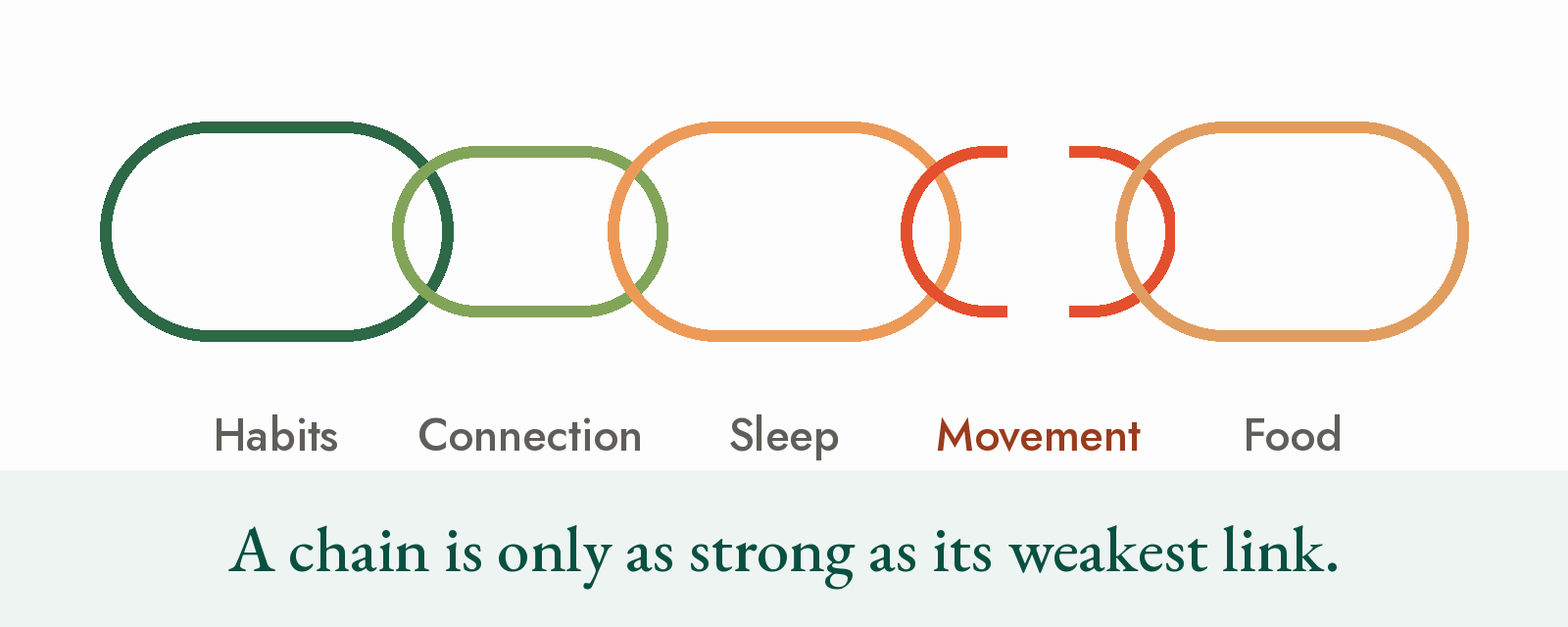
Ask a blacksmith how strong a chain is and he will not average the links. He will find the weakest one. Four flawless links and one cracked one do not make a chain that is eighty per cent strong. It breaks where it breaks, and nowhere else.
Your health stands on five pillars: your habits, your connection to other people, your sleep, your movement and your food. It behaves like that chain. Which means an average is generous to precisely the wrong person. It lets four strong pillars hide the one that is quietly deciding your future.
Why it catches the careful ones
This is the part I did not expect, and it is the reason I eventually wrote a book instead of another paper.
The people this costs most are not the ones neglecting themselves. They are the careful ones. They sleep, mostly. They walk most days. They eat better than most people they know. They take the supplements. And they still feel wrong, with nothing on any chart to explain it. That hardens, slowly and privately, into a suspicion that they are uniquely broken.
They are not. They are usually strong in four pillars and weak in one, pouring their effort into the four. Strengthening what is already strong changes very little.
That is the most discouraging arithmetic in health. It is also the most hopeful, because the reverse holds just as firmly: find the one link that is actually failing, and the whole chain gets stronger at once.
One thing worth doing this week
You need nothing from me for this part. No book, no laboratory, no app.
Sit for a few minutes and ask which of those five you have been quietly avoiding thinking about. Not the one you would score worst on paper. The one you flinch from. For most people the answer arrives embarrassingly fast, and it is usually the right one. We tend to know. We simply prefer to work on the pillar we are already good at, where progress is pleasant and visible.
That preference is most of the trap. Noticing it is most of the way out.
What this letter is
A letter most weeks, on what the research actually supports and what it does not. Some weeks that will be a single study worth your attention. Some weeks it will be a piece of the argument in the book. Occasionally it will be something I got wrong and have had to revise.
My book, Fix the Floor, comes out on 3 October. It carries the measuring side of all this: a way to score your current wellness status at home, honestly, in about fifty minutes, using a tape measure, a bathroom scale, a blood-pressure cuff if you have one (or the free machine at any pharmacy), and your own attention. You will hear about it here when it arrives. This letter will not turn into an advertisement for it.
Thank you for reading. If any of the above sounded like your own week, you are in the right place.
Aamir